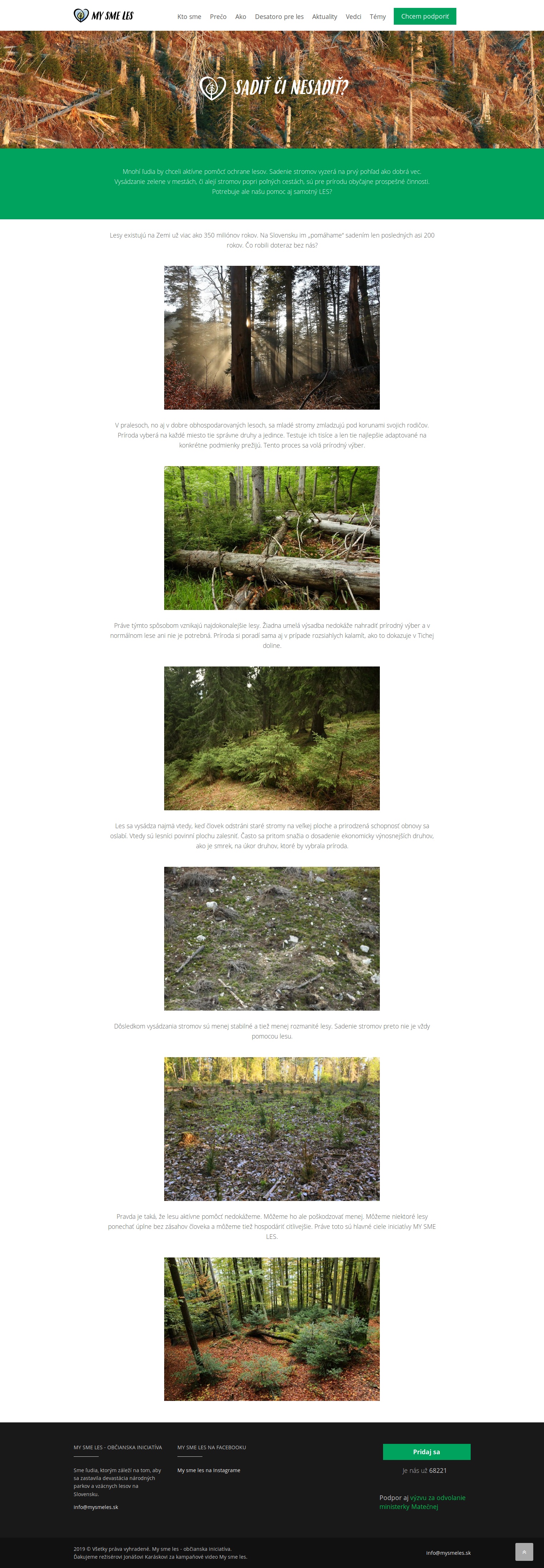
The fact is that a lot of trees are being cut down in national parks. While conservationists blame the foresters for this, saying that they are after money, the foresters claim that for many years they managed the forests according to the wishes of the conservationists (=without interference), the woodlice multiplied to an unacceptable extent, and then it was necessary to cut down many more trees – that is, entire areas of forest.
On the one hand, it is not a nice sight to see forests that have been cut down in large areas due to the attack of the bark beetle, on the other hand, the same bad sight and even worse is the spruce stand, which is left in a non-intervention regime. From an ecological point of view, the forestry strategy is better, because the foresters’ interest is to plant native and resistant trees there as soon as possible after the attacked trees have been cut down. In a non-intervention regime, a lunar landscape without greenery will remain there for many years.
There is nothing wrong in itself if the SOP (=State Nature Conservation) will have more power over national parks (=veto right over all forestry interventions – even over private lands which is unconstitutional), the problem is that the SOP controls a very strange ideological and almost sectarian fanaticism, that non-intervention is the only permissible way of nature protection. It is also unacceptable that the SOP prohibits private forest owners from taking remedial measures (=removing infested trees) whereby the overpowered lycovorous tree will cause them enormous property damage and eat up entire forests.
The Ministry of Environment is doing everything the third sector in the field of nature conservation wants, and the minister is not even hiding it. Nature conservation would be a very good thing if the third sector behaved really rationally. Yes, at first it seemed like an interesting experiment, to leave spruce monocultures to develop on their own, without intervention, what would they do. There was also a strong effort to imitate the West in everything, to follow the example of the German Bavarian Forest. Many activists actually managed to persuade state or private foresters to try the experiment of non-intervention (even under the threat of criminal charges, which often worked for legally uneducated foresters). But today it turned out that it was a mistake.
Even the Germans have figured out that the no-intervention experiment on spruce monocultures is not a good solution , they actually deployed the army to fight the bark beetle, and the reserve also had a forest hardvester (forest harvester) that can saw and delimb a single tree in a matter of seconds, as you can see in this video https://www.spiegel.de/video/waldsterben-im-harz-borkenkaefer-hat-katastrophale-folgen-video-99028976.html
Why does the third sector still fight for non-intervention even though it has been shown that non-intervention is a very bad solution? There are several reasons:
- Admitting a mistake is very difficult. A person’s ego is too high to admit a mistake. It’s too late to admit a mistake, it’s too humiliating. They have no choice but to stand by their word.
- Nature conservation has become a kind of ideological sect for us, and rational discussion is impossible.
- pseudo-nature protection as good business and corruption. Many people from the third sector are very well aware of the destructive impact of inaction, but they are all about money and corruption. Much more money is planned to be allocated for nature protection than before and it is an excellent way to steal money for doing nothing, or to investigate what has been investigated for very dubious scientific research long ago. Many corrupt subsidies from the Ministry of the Environment will go directly to the third sector, which will be entrusted with the alleged protection of nature. This is not just my prediction, it has already happened!! An incredible 600 thousand EUR of EU funds went from the Ministry of the Environment to dubious nature protection, according to Natura 2000, which is a pretty big amount for inaction and doing nothing in one area. The third sector is not afraid of a change of minister at all – regardless of the government or the minister at the Ministry of the Environment, the third sector has very strong roots in the ministry. Every single minister will be heavily bombarded with bribes to support overpriced nature protection. Minister László Sólymos blocked some activists on Facebook after they politely and respectfully asked him whether he had received a bribe for the dubious EUR 600,000 subsidy
Watch out for activist Juraj Lukáč
I would like to draw attention to the misleading arguments of this amateur activist, who has no education in the field of forestry. Mr. Lukáč is not so much a “conservationist” as a showman and conservation exhibitionist (e.g. taking a picture with a banner in the forest and then sharing it on FB, just to show some activity for sponsors). This person uses the argument that foresters cut down more wood than it has time to grow back . However, we must also take into account the argument of foresters who claim that the forest has a hundred-year cycle (a tree is cut down after about 100 years) and since the stands in Slovakia are not evenly distributed in age, it is natural that during these 100 years less is cut down in some years and more in others. Mr. Lukáč refers to his philosophy that wood harvesting must always be the same , he argues only by comparing harvesting with a 10-30 year period, i.e. not over a 100 year period. Mr. Lukáč did not understand the forestry system.
Further information
While in Slovakia, the Ministry of the Environment resembles a closed sect that does not want to discuss with anyone other than pseudo-conservation activists. By the way, László Sólymos has stated this publicly several times and said it quite frankly that he does everything as the controversial third sector tells him.
In the Czech Republic, the discussion around the woodpecker is much more rational, where the parliament recently rejected the expansion without intervention after heated discussions.
Germany vs. the lycopod crustacean. A radical change in nature conservation strategy. More info in the description after the video
Noninarka press institute Jana Kubisová from Aktualité promotes corruption and perverted ecoterrorism that damages nature. She turned a calculating businessman into a hero-protector of nature
Mentally disturbed journalist Jana Kubisová called the calculating businessman who owns the land a conservationist, although he himself does not consider himself one. He claims that he only cares about money, he does not want to be at a loss because planting trees is expensive, so it is easier to call for help from eco-terrorists who will pressure the authorities to turn the wasteland destroyed by the lycopods into a reserve. Then he will no longer be legally obliged to plant trees and will save money.
While Janko Kuciak was a wonderful and honest person who fought for legality, on the contrary, journalist Jana Kubisová promotes illegality, circumvention of the law, and damage to nature in her article. There are only two possibilities: either the journalist is mentally disturbed or someone is paying her.
If a forest cover is destroyed by a woodpecker, the owner of the land is legally obliged to reforest it by planting trees, which is understandably very expensive. The calculating oligarch, the owner of the land, Richard Benýšek, admitted in an interview that he is not interested in nature protection, but in money – he does not want to be at a loss. The guy wants to circumvent the law by calling in eco-terrorists (sectarian conservationists – people who tie themselves to dry trees) to help him, eco-terrorists who will put pressure on state authorities to declare his land – that wasteland – a no-go area, a reservation.
Ms. Kubisová is clearly not up to her job, she is a black sheep who infiltrated Aktualité, promotes circumvention and violation of the law, and does the opposite of what Kuciak does.
It is also very doubtful that Ms. Kubisová is interviewing a Czech oligarch – this directly contradicts the principles of Aktuály, which fight corruption.
Mrs. Kubisová may also have been thoroughly brainwashed by various eco-terrorist activists – sectarian nature conservationists. There are not only religious sects, but also pseudo-ecological sects.
The whole essence of the work of the pseudo-journalist Kubisová’s press institute lies in monitoring eco-terrorists, conservation sects on social networks such as OZ Prales or “We are the forest”, whose main philosophy is to fight against planting trees in forests destroyed by lykozrút. It would not even occur to her to give space to serious experts who have a different opinion on nature protection. This is even worse quality of journalism than alternative media do in terms of fanatically one-sided way of reporting.
Excuse me for my expression, but I would like to call Ms. Kubisová a certain vulgarity – it is no longer normal to be around people like that. https://www.aktuality.sk/clanok/723368/chcem-aby-sa-hluchan-vratil-vytvorime-mu-podmienky-hovori-sukromny-majitel-lesa/
Conservationists’ “scientific analysis” misused to attack foresters
In the end, I was able to find out later that the entire study was falsified. The results from the aerial photographs say the opposite, that in most cases the woodpecker was spreading from commercial forests to reserves.
Moreover, the abstract of the study has been radically changed since the study was officially released at a press conference in an unofficial preliminary form. The senior academic who was tasked with approving the study did not write anything in the abstract that would indicate the essence of the study – where the lycorrhiza spreads from, thereby indirectly revealing the very low relevance and demagogic methodology of the study.
I will post multiple perspectives on this analysis here.
There is also a controversial scientific study that was done by some foresters with the Slovak Academy of Sciences and the State Nature Conservation (ŠOP). It was a study, not scientific research as the ŠOP called it. The method of the study was to try to determine, based on satellite and aerial images, whether the wood borer was spreading from the reserve to commercial forests or vice versa, based on the dying of spruce forests. There were no personal visits to the reserve.
The text of the study itself sounds quite controversial and does not seem independent, as the study admits that it was done only to question the claims of foresters, which can cause emotions of anger and bias towards foresters who have a different opinion on the method of nature protection through non-intervention. Fortunately, the final text of the study was later edited into a more acceptable form compared to the version that was published at the press conference. It would also be very interesting to ask through the Freedom of Information Act who financed this study and to what extent. If it was mostly financed by the Ministry of Environment, then the independence of the study would be questionable. The Ministry of Environment falls directly under the Ministry of Environment, and the minister publicly boasted that he is a servant of third-sector fake nature conservationists, who are more reminiscent of conservation sects.
The aim of the study was to challenge the frequent claim by foresters that the wood borer is spreading from the uninhabited reserve into commercial forests. They therefore attempted to prove the opposite.
The extent to which this study is relevant is questionable. It would require a very detailed assessment by some independent expert, who would at least check their work on a smaller sample of the reservation. There could also be subjective interpretations and ideological adjustments of the results.
A very strong factor that could statistically greatly distort the analysis of conservationists is the fact that buffers can be much larger in area than reserves, especially in smaller reserves. Then it is statistically completely logical that on a larger area, that is, in buffers, where there are commercial forests, there will be more trees attacked by the bark beetle, so it logically deduces from this that the bark beetle spreads from buffers where there are more trees attacked into the reserve. In order for such an analysis to be truly statistically serious and objective, the surroundings of the reserve, that is, the buffers and the reserve itself, must always be of the same area. However, the methodology of this analysis claims that buffers have a fixed distance from the borders of the reserve, so with such a methodology, it is fundamentally impossible to make an objective or relevant analysis. The distance between the buffers and the reserve is up to 2,000 meters, so imagine a reserve with an area of 1 square kilometer and a two-kilometer buffer around its borders. The buffer area would thus exceed the area of the reservation several times. And reservations with small areas are the vast majority in terms of number.
However, we can say with certainty that the boys were wrong at least in the Sokolec reservation in the Tribeč Mountains.
In any case, according to their results, only in two-thirds of the reserves did the woodpecker spread from the commercial forest to the reserve. In one-third, the situation was different, so the study does not in any way challenge the traditional claim of foresters that the woodpecker can often spread from the reserve to the commercial forest.
The director of the Forest Service officially released this study at a press conference, where he furiously criticized the foresters, significantly misinterpreting the official results of the study, because the study does not in any way challenge the traditional claim of the foresters and the study itself also documents the penetration of the woodpecker from the reserve into commercial forests.
Although the director of the SOP presented the study at a press conference as a triumphant victory over the foresters, the truth is that there is nothing to celebrate, because the conservationists contradict themselves. The SOP and NGOs would like to extend the non-intervention in national parks to their parts that are now commercial forests, which they say are spreading the lycopod to the reserve. This is called pissing in the mouth. The current amendment to the law strengthened the non-intervention in national parks, which was contrary to the aforementioned study.
https://www.aktuality.sk/clanok/728856/prezidentka-podpisala-novelu-zakona-o-ochrane-prirody/
https://www.teraz.sk/slovensko/z-caputova-chce-dokladne-analyzovat/418971-clanok.html
Another dimension of the problem. The director of the ŠOP criticized foresters for the fact that the wood borer is spreading from commercial forests to the reserve. The catch, however, is that he criticizes foresters for what the conservationists themselves are responsible for. However, conservationists bear more responsibility for this phenomenon than foresters, in this way nature conservation only criticizes itself. First of all, conservationists should be the first to protect their reserves. They only discovered very late, in 2018, that the wood borer is spreading from commercial forests to the reserve, and even then only from satellite images, not based on physical visits to the reserve. So that is not a good calling card for nature conservation. The role of nature conservation is to walk the terrain, not sit in offices. Conservationists have no idea what is actually happening in the reserves.
Most of the area of national parks consists of commercial forests and a smaller part of reserves.
If it turns out that the bark beetle is spreading from the commercial forest to the reserve, it is the duty of conservationists to alert foresters to this phenomenon and ask them to remove the attacked trees. Foresters do not have the right, but rather the duty, to cut down attacked trees in national parks in commercial forests. Conservationists are also obliged to provide foresters with all the permits they need to do so. If foresters do not fulfill their duty, then conservationists can file a criminal complaint against foresters. In practice, however, we know that this does not work. Conservationists in national parks try to complicate the fulfillment of their duties as much as possible for foresters and have never asked foresters to carry out remediation in commercial forests, i.e. remove attacked trees.
Scientific analysis refutes foresters’ claims about the bark beetle disaster http://www.sopsr.sk/web/?cl=20380
Foresters’ mistakes
While fake conservationists have been very active for over 20 years, they do a lot of activism, are active on social networks, communicate with politicians, the media,
Foresters are only now starting to wake up that communication with the public should not be underestimated. Foresters woke up late. But better late than never. 20 years of persistent activism by conservation organizations from the third sector have left their fruits against the civic inaction of foresters.
Foresters have not understood that if they want to have the public on their side, they must be active on social networks, they must actively try to assert themselves in the media, they must do activism, they must communicate with the public and inform it. If all landowners in Slovakia were to financially join forces in a non-governmental organization with five full-time employees who would do activism, public opinion and politicians could be much more favorable to foresters.
The We Are the Forest initiative has declared war on tree planting
https://www.mysmeles.sk/sadit-ci-nesadit