Catholics do not know their own history. Alternative media do not tell the truth and strongly mislead their readers. Arguing with the concept of traditional values is wrong, because in the past there were traditional and homosexual marriages in the Catholic Church, which were inspired by pre-Christian culture in Europe. There are also serious scientific academic works that prove that in the past there were church marriages in the Catholic Church, which everyone can find in English. Many conservative Catholics will have a mental breakdown after reading this article. Let's not forget the moment when Pope Francis was sharply criticized by conservative Christians for having a tolerant attitude towards same-sex couples.
It may also seem strange to some how it is possible that the church allowed same-sex marriages when there are so many verses against gays in the Bible. The catch is that most of the verses in the Bible against gays are poorly translated in terms of translation – the translations are mainly inspired by Martin Luther, who is known to have hated homosexuals very much and was the first to translate the Bible into an understandable language (Greek or Latin and especially the Hebrew Bible – their literal translation is completely incomprehensible to a 21st century person and therefore the translations are very subjective and provide a lot of room for the translator's imagination). The Old Testament does not contain any statements against homosexuals (on the contrary, the clear relationship between Jonathan and David), the New Testament contains only one place against gays, which was not taken seriously by the church in the past. In the past, the church did not consider homosexuality to be something that contradicted the Bible.
The first views in the church condemning gays began in the 11th century, when homosexuality first began to be associated with Sodom http://en.wikipedia.org/wiki/Homosexuality_in_medieval_Europe
Below is an article by Blažena Ovsená copied from the website sclabonia.sk. I would like to point out that the article is not mine and I do not agree with all of Ms. Ovsená's bold opinions/theories.
Warning!!!: Boswell, whom the author quotes/translates, is not an amateur journalist, but a professional historian and professor of history at a prestigious university.
We already had church homosexual unions under Svätopluk.
Almost no one knows that same-sex unions were known in early Christianity, probably even in the empire of Svyatopolk. This is quite unimaginable from a contemporary perspective, since today's Christianity has a negative attitude towards homosexual unions.
Indeed, there is written evidence that there were Christian ceremonies for the marriage of two people of the same sex in early Christianity. I read about this in the book Same-Sex Unions in Premodern Europe by John Boswell. John Boswell died of AIDS at a relatively young age, a year after the book was published.
Boswell documents that written records of same-sex unions in pre-modern Europe have been preserved in Greek, and imagine, in Slavic(!) – specifically from the territory of Macedonia and Serbia. They are descriptions of Christian church ceremonies written in the Glagolitic Slovak script. Thus, we know that two married men were called pobratimy in Old Slovak and two married women were posestrymy . There is even a preserved church ceremony blessing such a union, which has the title molitva na bratvorenie (prayer for brotherhood), later kin bratvoreniu . Later, in modern times, this ceremony began to be called pobratimstvo . The word brother once had two meanings. One was brother as a sibling, the other was brother in the sense of lover. For contemporaries of the time, it was the meaning of lovers and a form of erotic union with a romantic bond.
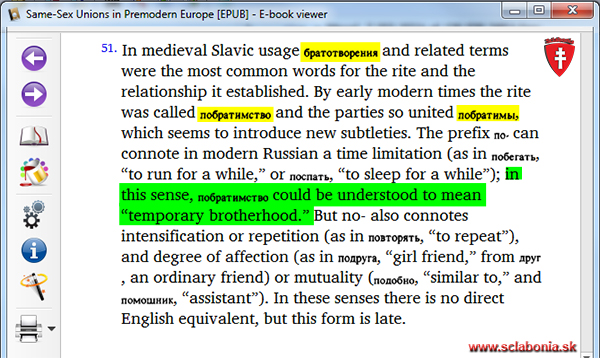
The Slavs had a name for same-sex unions – an excerpt from the book Same-Sex Unions in Premodern Europe by John Boswell.
It is questionable where these same-sex unions had their roots. Personally, I think that they certainly date back to pre-Christian, i.e. pagan times. I think that these unions must have been known already in the so-called Great Moravia, or rather in Svätopluk's Slovak Land .
As we know, the Western Roman Rite was already present in our country through the Frankish clergy. The Eastern Roman Rite was brought to us by Cyril and Methodius. Cyril died young and sick, in my opinion infected with some venereal disease, as I have written several times in other articles (e.g. here ), and in my book. We can almost certainly say that Cyril was homosexual. His biography says that he was very beautiful, but he did not desire the gift of a woman. If he had a sexual life, and he certainly did, it was certainly not with women. Cyril attended the university that Michael III, later the Byzantine emperor, who sent both brothers, Cyril and Methodius, also attended. Michael III was homosexual and appointed Basil, a tall, powerful, muscular man, as his bedfellow/chamberlain. It is about Basil that it is preserved that he concluded at least one fraternity, but there are reports of two. From this it logically follows that Cyril must have at least known the status of brotherhood and therefore the Byzantine Christianity that he brought to us knew this status. If all this were true, it would mean that in Slovakia we had same-sex church unions over a thousand years ago, and we even had our own terminology for such unions – brotherhood and posestrimstvo . It is possible that the split between Roman Christianity and Byzantine Christianity occurred in our country precisely because of the marriage of same-sex couples. I cannot say this for sure, but I am almost certain that the whole story of the so-called Great Moravia, as I have already written in my book The Search for Secret Slovak History and the Slovak Spirit , was in fact one big homosexual saga. It was homosexuals who decided the fate of the so-called Great Moravia, the Slovak land. Personally, I think that if Emperor Michael III. was not such a weirdo and a rabid homosexual, but for example an old prudent ruler, he would never have sent missionaries to us, because he might have feared a threat and a major conflict, perhaps even war. It was his youthful foolishness and his schoolmate relations with Cyril, in my opinion, that caused him to send both brothers to us without hesitation. If Michael III. had not been homosexual, Russians would probably not write in Cyrillic today. Perhaps most of the southern Slavs would also have assimilated among other nations. Perhaps Russians would not be able to build space rockets today and Russia would not be so big and prosperous. What all did one homosexual cause…
To get an idea of the environment from which Cyril and Methodius came to us, I will present my own translation of an excerpt about Basil from John Boswell's book Same-Sex Unions in Premodern Europe .
John Boswell, Same-Sex Unions in Premodern Europe : Several centuries later, Basil I (867-886), founder of the Macedonian dynasty that ruled the Byzantine Empire from 867 to 1156, was recorded in documents as having been twice involved in ceremonial unions with other men. Although the most important sources for his life – compiled under the reign of his descendants some centuries later – are contradictory on some points and occasionally untrustworthy, they are largely consistent with each other. His biographers all agreed that when Basil arrived in Constantinople with nothing but a stick and a knapsack – a young boy from the provinces with no ties to property – he befriended a certain Nicholas of the Church of St. Diomed, who saved him from sleeping on the street, brought him to the church, bathed and clothed him, and supported him for some time until the ambitious Basil was able to attract the attention of a well-situated courtier who was a relative of the imperial family.
In most accounts of their relationship, Nicholas and Basil are married in a church ceremony. According to one tradition, the morning after Nicholas found Basil, Nicholas "bathed and clothed Basil and was ceremonially married to him, and had him as a roommate and companion." Another version is much more precise about the ceremony: "and the next day he went with him to the baths and gave him new clothes and went with him to the church, where he formed a formal union with him, and they rejoiced in each other." The strange last passage would probably have reminded a Greco-Christian reader of the biblical: "Rejoice with the wife of your youth."
The words in the chronicle (one uses adelphopoièsiz , the other adelphopoiètoz ) and the fact that the union took place in a church leave little doubt that the writer is referring to some form of church ceremony, which is published and translated in this text. There is no hint of any tribal or familial aspect to the relationship, nor any exchange of blood; it had no military or strategic aspect, nor are any circumstances documented that would require or cause it (e.g., rescue from danger, serious illness, all of which would be causes in later Slavic relationships based on this model). It is clearly a personal relationship, undertaken for personal reasons. Both Basil and Nikolas had living biological brothers with whom they were in regular and close contact, so it would hardly have been inspired by the need for a sibling. Indeed, it was Nikolas's own biological brother, a doctor, who was responsible for introducing Basil to the court, a fact documented immediately after the union in both versions. Nor does the mention of rejoicing suggest a cold, calculating relationship. Taking into account Hamartolos's claim that the union led to the sharing of home and hearth, this strongly suggests a wedding followed by a feast and a shared life.
…
From Basil's perspective, who would otherwise be sleeping on the street, formalizing Nikolas's benevolent interest in him could have been advantageous, at least until he found a way to advance his career faster with someone more powerful and well-known. It is less clear what Nikolas gained from such a sudden union. If we take the story literally – including Nikolas's supernatural information about Basil's amazing future – one might infer that Nikolas imagined that he would eventually profit from entering into a formal union with someone who would one day become emperor. But what kind of relationship was it? The explanation is given by Basil's subsequent career. He later entered the service of Theophilos, who, in the words of one chronicler, "had a great interest in well-born, good-looking, well-built men who were very muscular and strong," and when he saw how exceptional Basil was in these respects, he made him protostrator (chief stable master). Basil "was loved by him more and more each day." Basil was thus what modern Americans would call a "hunk," and was the object of the greatest admiration by his contemporaries, whether men or women.
While Basil was still in the service of Theophilos, they took a trip to Greece together. A wealthy widow in Achaia showered him with gifts of gold and dozens of slaves. For her generosity, she asked for nothing but that Basil enter into a ceremonial bond with her son John. At first he refused, thinking that he would then look "cheap", but he finally agreed to her long persuasion. "I seek nothing from you nor do I ask anything of you," she assured him, "only that you love us and treat us kindly." A preserved medieval illustration of this incident shows Basil and John married before a priest in a church, with the Gospel open before them and John's mother watching. The accompanying picture depicts Basil, John, and Danelis (John's mother) at a table – undoubtedly the artist's depiction of the celebration that usually followed such a ceremony.
When he subsequently became emperor, Basil immediately "sent for the son of the widow Danelis, granted him the title of protospatharios , and guaranteed him intimacy with him based on their earlier shared life in the ceremonial bond." The widow herself – now too old to ride – came to the emperor on a stretcher, but instead of asking him for any generosity, she brought more extravagant gifts "than almost any other foreign ruler had given to the Roman emperor up to that time." Moreover, she "who deserved to be called the emperor's mother" gave a large gift from her inheritance in the Peloponnese to her son and the emperor together .
If gender were not included, this incident would seem to be a fairly familiar feature of the pre-modern political map: a wealthy widow offers her marriageable child to a powerful young man on the rise, along with a proper dowry, hoping to combine her wealth with his. Basil's own father was married to the daughter of a wealthy widow in a similar parallel. The previous Byzantine dynasty, the Amorians, was founded on similar, but apparently heterosexual, circumstances: born to poor parents, uneducated and without contacts, its founder Michael II advanced through the strength of arms and military ability until he was able to marry Thekla, the daughter of a high-ranking officer, thus attracting the attention of Emperor Leo V, who made him protostrator – the same position Basil held in the service of Theophilos – and became the godfather of one of his sons. When Leo tried to remove Michael on charges of treason, he himself was murdered and Michael was crowned emperor.
The widow Danelis was much richer than Basil, and when he became emperor, she realized that she would gain nothing material from the relationship, so it could hardly be seen as a self-serving plot on her part. On the contrary, every year of Basil's life she sent him expensive gifts, and years later, when both Basil and her son died, the widow came again on a stretcher to visit Basil's son Leo, now emperor, and made him her heir, although she had a grandson and other relatives.
The two stories about Basil are similar: in both, there is a divine revelation to a priest or monk about Basil's amazing career; in both, the relationship that was established serves Basil's benefit. It is possible that it was later known in imperial circles that Basil significantly benefited as a young man from a formal relationship with another man, and different chronicles simply added different details. Each of the biographies, which were written only a century after the events, contains either one or the other same-sex union; neither contains both. On the other hand, Nikolas appears in all the most important documents about Basil's life as a benefactor, even those that mention the union with John, and the rich details about the widow Danelis (including her subsequent relationships with Leo) make it unlikely that she was a mere fabrication. Probably Basil was in a union with both men. It is not clear whether this was inappropriate in Basil's time – or that problems regarding property would have an impact on his behavior.
After Basil had formed his relationship with John and Danelis, he was taken into the service of Emperor Michael III [who sent Cyril and Methodius to us, note BO], a strange young man in his late teens, who enjoyed dressing as a prelate and indulged his passion for horses and riding. Michael became so attached to Basil that he appointed him "bedroom companion" – larakhopsòmenoz , a position usually held by a eunuch – and adopted him as his son, even though Basil was certainly older than the emperor. Finally, he appointed Basil as co-emperor in a dramatic public scene, announcing that he did so because Basil had saved him from potential assassins (by which he meant his uncle, Bardas, who had been his closest colleague and advisor before Basil jealously murdered him in front of the emperor's eyes), and based on "the great love that Basil gives me."
One of Michael's modern biographers somewhat reluctantly observes his relations with Basil:
“The intimate friendship between the Emperor Michael and the Armenian servant … suggests a picture of a not very agreeable nature. Bad as Michael’s character was, … it seems that we must also credit him with homosexuality: and this is confirmed, both by his making him his bedfellow, and by his choosing, when Basil ceased to amuse him, a handsome boy in his stead as his favourite.”
Liudprand of Cremona, a Western contemporary of Basil, who had been in Constantinople learning Greek, and whose family had been connected to the court for generations, simplified the story in his Latin version, but alluded strongly to the same point:
“The Emperor Basil … was of a poor Macedonian family, and came to Constantinople … under the yoke of poverty to serve a certain abbot. So when Michael, who was then emperor, came to pray at the monastery in which [Basil] was working, he saw that he was exceptionally handsome and addressed the abbot and asked if this boy could be given to him (or: that he could be given to the boy). Taking him to the palace, he gave him the office of companion in the bedchamber [chamberlain].”
About a year later, Basil arranged and participated in Michael's assassination in his bed, and from then on ruled alone. The rare complexity of imperial sources during this period makes it difficult to decode the dynastic relationships between Michael and Basil before Michael's death. Bury summarized the matter thus:
“The confidential intimacy which existed between Michael and his bedfellow/chamberlain [Basil] is attested by an interesting marriage arrangement which the emperor approved. Basil was already married, but Michael caused him to divorce his wife and marry him to his own former mistress, Eudocia Ingerina. But this was only a formal marriage; Eudocia remained the emperor’s mistress. Basil was also provided with a mistress of suitable rank, though not of tender years. … Thus three virgins, Eudocia Ingerina, Eudocia Augusta of Decapolis (Michael’s wife), and Thecla Augusta, filled between them four positions as wives and mistresses of the emperor and chamberlain.”
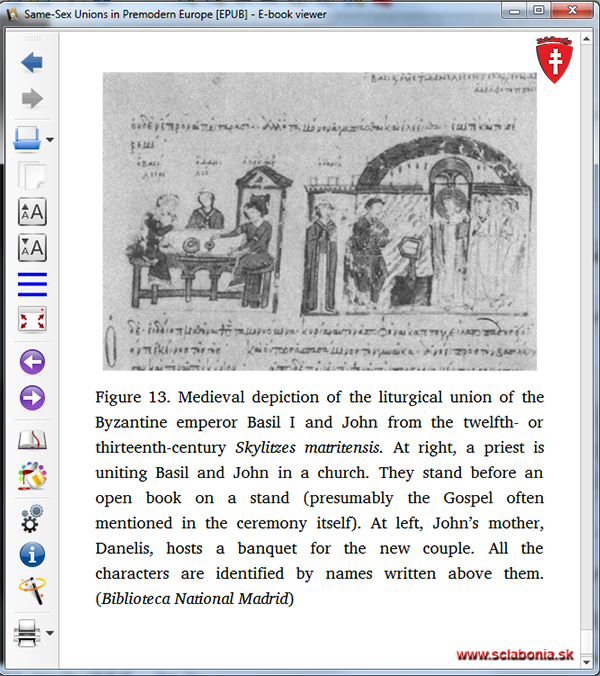
Figure 13. Medieval depiction of the ecclesiastical union of the Byzantine emperor Basil I and John from the 12th or 13th century. Skylitzes matritensis. On the right, a priest marries Basil and John in a church. They stand before an open book (probably the Canticles, which is often mentioned in the ceremony itself). On the left, John's mother, Danelis, hosts a party for the new couple. All the figures are identified by the names written above them. (Biblioteca National Madrid)
John Boswell's book goes on to say: From the 14th century onwards, Western Europe had taken on a fierce and obsessively negative bias towards homosexuality as the most terrible of sins. In the Greco-Christian world, this change was less extreme but still evident. As a result, same-sex unions became a kind of legalization of "the sin that could not be named." In the 19th century, a synod of the King of Greece banned these ceremonies as "an act against the law, against nature, … against sound judgment, a soul-destroying evil and error, a strange and incomprehensible union, an act against God and the law, an institution outside and quite foreign to the Church." The rite disappeared from most of Western Europe, except in Central and Eastern Europe, and no Latin versions survive, although they must have been performed in Latin in Ireland, and probably at some time in Italy.
…
In some regions, local authorities may have banned these ceremonies, but this probably had little impact on the ancient and deeply-rooted Christian ritual. The Bishop of Ponzoni in central Dalmatia banned the ceremony in 1620, but more than a century later, Alberto Fortis was a witness and admirer of such a ceremony between two women, held in a church in Dalmatia.
“Friendship, so sensitive between us that it can change for the slightest reason, lasts a very long time among the Morlaks. They have made it something of a part of their religion, and they form this sacred bond before the altar. The Slavic rite has a special prescribed prayer, which unites two friendly persons – two men or two women – in the presence of the whole congregation. I attended the union of two girls who became posetras in the church of Perusic. The happiness that shone in their eyes after the sealing of this sacred bond demonstrated to those present what delicacy of feeling resides in their souls, unsullied – or, to be more precise, uncorrupted by the society we call ‘civilized’.”
The following is the Sinaitic Euchologion [11th – 12th century] [Old Slovak] The text comes from Macedonia, but is written in Old Slovak, with Glagolitic letters. The text was published by Rajko Nahtigal, Euchologium Sinaiticum . Starocervnoslovanski Glagolski Spomenik, Slovenska Akademija Znanosti in Umetnosti v Ljubljani. Filosofsko-Filološko-Historični Razred, 1 (1941). I am translating from English into Slovak. Excuse the quality, but I am not very familiar with church terminology. It is clear that I will not agree literally with the Bible. For that, the passages quoted from the Bible would have to be copied out exactly.
Prayer for Fraternization (Bond of Two Men) Placing them before the altar, the Dean says this Dean's Prayer: In peace we pray to the Lord. For the peace of heaven. For the peace of all. For their union in the bond of love and life, let us pray to the Lord. For these servants of God, _______ and _______, and for their union in Christ, let us pray to the Lord. That the Lord our God may unite them in perfect love and indissoluble life, let us pray to the Lord. That continence and sincere love may be granted to them, let us pray to the Lord. For the sanctified gift of the precious Body and Blood of Jesus Christ, which they may receive without sin and endure in the bond without envy, let us pray to the Lord. That all things necessary for salvation may be granted to them and to us, let us pray to the Lord. That they and we may be protected from suffering, danger, and need. Protect, protect. The holiest, the purest.
ii. Prayer for Same-Sex Marriage. O our Lord God, who grant us what we ask for our salvation, who have commanded us to love one another and forgive one another our sins, bless, O Lord, the Host of goodness, the Lover of mankind, these two of Your servants, who love one another with the love of the Spirit and have come to Your holy temple with the desire to receive Your sanctification and blessing; grant them fearless faith and sincere love, and just as You gave Your holy disciples and apostles Your peace and love, grant them also, Christ our God, giving them all those things that are necessary for salvation and eternal life. ( Exclamation ) For You are the light of truth and eternal life, and to You we give glory and praise, the Father and the Son and the [Holy Spirit].
iii. Then the Dean prays: Let us hear the wisdom of the Holy Gospel.
The priest reads from John [17:1, 18-26]: Jesus lifted up his eyes on his disciples and said, “Father, … As you sent me into the world, even so I have sent them into the world. And for their sakes I sanctify myself, that they also may be sanctified through the truth. I pray not for these only, but also for them which shall believe on me through their word; that they all may be one; as you, Father, are in me, and I in you, that they also may be in us: that the world may believe that you have sent me. And the glory which you have given me I have given them; that they may be one, even as we are one: I in them, and you in me, that they may be made perfect in one; and that the world may know that you have sent me, and have loved them, as you have loved me. Father, I will that they also, whom you have given me, be with me where I am; that they may see my glory. the glory which thou hast given me: for thou lovedst me before the foundation of the world. O righteous Father, the world hath not known thee: but I have known thee, and these have known that thou hast sent me. And I have declared unto them thy name, and will declare it: that the love wherewith thou hast loved me may be in them, and I in them.”
It is to be found on the seventh Sunday after Easter. And when the priest finishes the Gospel, the dean intones the dean's prayer.
iv. The priest makes a prayer before the table: Almighty God, who created people in Your image and according to Your liking and gave them eternal life, who rejoiced that Your holy and glorious apostles Peter and Paul, and Philip and Bartholomew, were united not by blood, but by faithfulness and love, who considered it necessary to meet so that the holy martyrs Sergius and Bacchus could be united, bless also these Your servants, _______ and _______, united not by birth, but by faith and love. Grant them to love each other, let them continue without envy and without temptation for all the days of their lives, through the power of Your Holy Spirit and the prayers of the Holy Mother of God and all Your saints who have glorified You throughout the ages. ( Exclamation ) For Yours is the power and Yours is the kingdom, Yours is the strength [and glory. In the name of the Father, the Son, and the Holy Spirit, now and forever. Amen.]
v. The priest raises his voice and prays: Peace to all. Dean: Let us love each other. Then the priest kisses the couple and they kiss each other. Then the dean prays: Let us bow our heads before the Lord.
vi. And the priest says his prayer in silence: O Lord, our God, You are the author of love, the ruler of peace and the savior of all, give us Your love, the fulfillment of the law, and grant us to think of what is from Jesus, Your Son, our Lord. Grant us to receive one another with love, as Your only Son received us, and grant us to serve one another in love and most heartily fulfill the law of Christ. ( Exclamation ) For Yours is the glory and power, Father, Son [and Holy Spirit].
vii. And then the priest prays, raising his arms: And grant us, O Lord, to serve You truly. People: Our Father, [who art in heaven, hallowed be Thy name, Thy kingdom come, Thy will be done, on earth as it is in heaven, give us this day our daily bread, and forgive us our trespasses, as we forgive those who trespass against us. And lead us not into temptation, but deliver us from evil. Amen.] (To the end.) ( Exclamation ) For thine is the kingdom, the power, and [the glory].
viii. And then the dean says: Behold the holiness for holiness. And the priest, raising the baldachin over the altar, says: Behold the sanctified holiness of the saints. People: You alone are holy, O Lord, Jesus Christ. And he gives communion to both.
ix. And after the reception, the priest takes the elder of those taken, and that elder takes the younger by the hand, and the priest, leading them both, sings the eighth tone of David. Lord, [lead me] in [Your] truth. Turn again, O God of hosts, look down from heaven, behold and visit this vine; And the place of the vineyard which Your right hand has planted…. (Verse) Blessed is the man who feared the Lord, who greatly delighted in His commandments. Lord, Lord, look down from Heaven. (Verse) Hear, O Shepherd of Israel, You who lead [Joseph like cattle];
x. (Verse) [Behold,] how good and how pleasant it is [for brothers to dwell together in unity. It is like precious oil on the head, which ran down to the beard, even Aaron's beard: which ran down to the hem of his garments; Like the dew of Hermon, and like the dew that descended from Mount Sinai: for there the Lord commanded the blessing, even life forevermore.]
And so, singing this whole psalm, verse by verse, to the end, they add this verse: Lord, Lord, look down from Heaven….
xi. Then they sing the hymn of the martyrs, following the tone.
xii. And then: Glory be to the Father and to the Son: and to the Holy Spirit. As it was in the beginning, is now, and ever shall be: world without end. Amen.
xiii. A hymn to the Mother of God.
There is also a text in Serbian from the first half of the 14th century.
Who were Serge and Bacchus?
Serge and Bacchus were two Roman soldiers of high rank at the end of the 3rd and beginning of the 4th century, who enjoyed such a close friendship with Emperor Maximian that they could have a friend appointed as governor of a province. They were also Christians, united in their mutual love in a way that resembled a Christian heterosexual married couple.
It was then that Serge and Bacchus, like stars shining joyfully on Earth, radiating the light of faith in Jesus Christ, began to enchant the palace.
Being as one in their love for Christ, they were also inseparable from each other in the army of the world, united not by nature but through faith, always singing and saying, "Behold, how good and how pleasant it is for brothers to dwell in unity!"
After a while, indeed, they provoked envy in the less popular ones. Their worst enemies denounced them for being Christians, which aroused the emperor's anger. He ordered them to sacrifice to his idols. They refused.
The emperor immediately ordered their belts, tunics, and all military ranks to be cut off, the gold necklaces were taken from their necks, and they were dressed in women's clothes; thus they were led through the middle of the city to the palace, wearing heavy chains around their necks.
Bacchus was flogged to death in such a way that those who flogged him were tired after the act. Serge was imprisoned.
The ruler, frustrated by his defeat, ordered that Bacchus not be buried, but thrown behind the camp as meat for dogs, wild animals, and birds. Then he got up and left. When the body was thrown near the camp, a crowd of wild animals gathered around it. Birds flying in the air did not allow the bloodthirsty beasts to touch him and kept watch during the night.
Meanwhile, the blessed Serge, deeply depressed and heartbroken by the loss of Bacchus, lamented and cried, "No longer, brother and fellow fighter, will we sing together, 'Behold, how good and how pleasant it is for brothers to dwell in unity!' You are freed from me and have gone to heaven, leaving me here alone on Earth, now I am just one, without comfort."
After he had said these things, that same night the blessed Bacchus suddenly appeared before him with a face as radiant as that of an angel, wearing a military uniform, and spoke to him. "Why do you weep and mourn, brother? If I have been taken from you in body, I am still with you in union, singing and reciting, 'I will run the path of the commandments when you enlarge my heart.'
"Then hasten, brother, through a beautiful and perfect confession, to surrender yourself and gain me when you have finished the journey. For the crown of righteousness is to be with you for me."
The next day, Serge was forced to run nearly 10 miles in shoes with nails driven into the soles. Antiochus rode alongside him in a carriage. During the night, his feet healed, which Antiochus thought was witchcraft when he saw that Serge had no trouble walking the next day. He forced Serge to run another 9 miles in the same cruel shoes, and when this did not deter him, he ordered him to be executed.
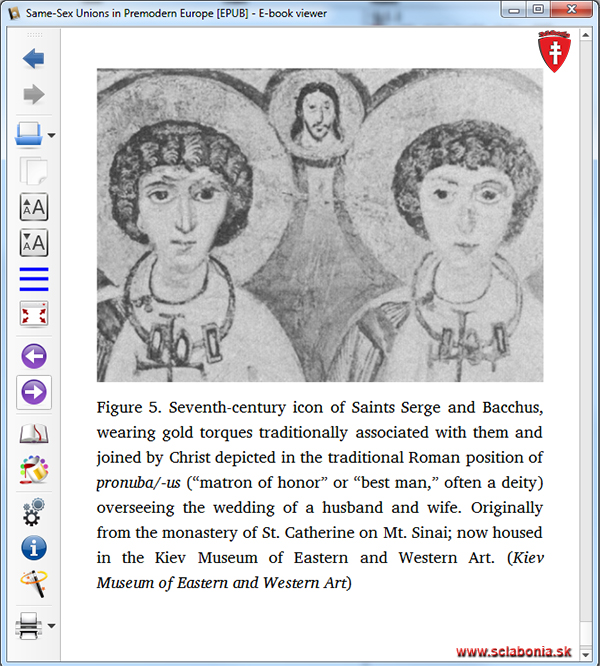
Figure 5. 7th-century icon of Saints Sergius and Bacchus, wearing the gold necklaces traditionally associated with them, and with Christ in the traditional Roman position of pronuba/-us (“matron of honor” or “companion,” often a deity), overseeing the marriage of a man and a woman. Originally from the Monastery of St. Catherine on Mount Sinai, now housed in the Kiev Museum of Eastern and Western Arts.
Conclusion
I always thought that the Christian rejection of same-sex unions was the work of Satan and the evil spirit. As I have just shown, same-sex unions were certainly known to Cyril and Methodius. They may have been practiced in our territory during the reign of Svatopluk. I would not be surprised. Christianity only became distorted later, when it became so rich that it needed to direct its gaze from its stolen money somewhere else – homosexuals took advantage of it. So homosexuals are still paying for stolen Christian wealth to this day. A wise person understands this deception, and a good person will join the side of goodness and fundamental truth.