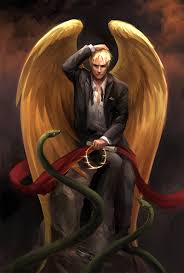
 The church itself called its archenemy Lucifer, meaning the bearer of light, the church gave him an amazingly beautiful name, something positive. So the church itself admitted that Lucifer is good and logically the opposition to Lucifer is evil. The church admitted that it is on the side of evil.
Furthermore, the church also calls Lucifer the term Satan, which means adversary, adversary, opposition to the evil cruel god Yahweh.
What does the church say about Lucifer? The Catholic Church says that Lucifer was originally an angel who betrayed God, who punished him and made him a demon, the leader of all demons.
The church's arguments against Lucifer do not hold up:
-why didn't the church give him some other name that would be evil and ugly? Why didn't they give him some other second, more evil name besides Lucifer? Isn't it strange that the alleged leader of demons has exclusively either positive or neutral names and no negative names?
-do you think it's a coincidence that the Church didn't come up with a name for the chief of demons that meant something downright evil?
– further, if the church wanted to, it could have avoided the positive concept of Lucifer completely by simply not inventing the whole story about fallen angels. But we see that the church did not do that, it actively invented the story about Lucifer on its own initiative. The Bible does not mention fallen angels, it is just a forced interpretation of some verses of the Bible. The church was not forced at all by the Bible to invent the story about fallen angels. The church could, for example, invent the story about demons, who have always been evil
I have already explained the terms Satan and Lucifer. The term Beelzebub is still used. In the Catholic Bible commentaries, but Beelzebub also does not mean anything bad:
The name Beelzebub means: Lord of the Flies. Flies spread disease, so he was the god of disease and healing. In the New Testament (Greek) he is Beelzebub, i.e. Lord of the (heavenly) dwelling place (Mt 10:25; 12:27). The New Testament gives this name to the prince of evil spirits.
Source of information: http://dkc.kbs.sk/dkc.php?frames=1&in=2kr1
(click on the number on the right)
By not giving the alleged leader of demons any bad name, the Church essentially admitted that it was on the side of evil itself:
Beelzebub – neutral meaning
Satan – adversary, the word adversary in itself does not mean anything bad, it means opposition, adversary means "oppositional". Satan is therefore the opposition (or enemy) to the evil Yahweh. (The word satan originally comes from the Old Testament). Opposition to the evil Yahweh can only mean good again. Because opposition to evil is good
Lucifer – a purely positive term
********
However, I do not want to promote Satanism in any way. That is definitely not what I wanted to say with this article. Satanists are crazy. But I explain with the article that the church has admitted that it is evil.
Satanic trends are as primitive as religion itself, it is a kind of childishly primitive naive opposition to Christianity. And maybe they really do cooperate with real forces of evil – as shamans say: black magicians bruchos really exist
http://cs.wikipedia.org/wiki/Lucifer
http://en.wikipedia.org/wiki/Lucifer
http://sk. wikipedia.org/wiki/Satan
Here is the difference between Luciferianism and Satanism explained
http://en.wikipedia.org/wiki/Luciferianism
Who are demons? It cannot be ruled out that demons and devils were called good, luminous beings by the church who tried to help people free themselves from the slavery of the Christian religion in the Middle Ages.
Who is Lucifer? It is not entirely certain whether Lucifer really exists or not. It could be the general oppositional principle of the church – the forces of good. Or it could be the supreme good being of light, who guards planet Earth and all of humanity from evil. But let's leave aside the nonsense of crazy Satanists.