According to the official teaching of the Catholic Church and Protestants, the Bible is considered a living, authentic, and infallible revelation of God. Christians believe in the complete and absolute perfection of the Bible. Unfortunately, I am a "bad" person and I will awaken Christians from their beautiful dream to a harsh reality. The truth is unpleasant. The Bible is far from the nice and pleasant fairy tale that Christians have thought it to be until now. Some Christians (especially the practicing and fanatical ones) may even have a mental breakdown from this article, fall into depression, or even be "struck down" by it. A Christian has based their entire meaning of life on Christianity, but now here is an unpleasant article that questions their entire faith. The article will spoil the Christian's joy.
What is the point of this insane frenzy of fanatical Christian preachers and evangelists who are trying with all their might to draw as many sheep as possible to Christianity, which is already founded on lies? After all, Christianity is questioned by the Bible itself.
When Christians hear the term Judas' Gospel , they might think it's some "satanic" apocrypha. That's not true at all. It's an apocrypha that is in accordance with the Bible.
In this gospel, Judas is mentioned as the best apostle, who staged the betrayal to "free" Jesus from the body.
The Gnostics believed that the human body is an obstacle to rebirth; they considered the body to be evil.
In the Gospel of Judas, Judas thus seemed to have helped "free" Jesus from the body by helping him to die. According to the Gnostics and the Gospel of Judas, Judas was considered a positive figure.
Wikipedia on the Gospel of Judas in Czech
Wikipedia on the Gospel of Judas English
The Gospel of Judas is surprisingly consistent with the Peshitta (the Aramaic original of the Bible).
Judas is referred to as a traitor, the one who betrayed. The Aramaic word for "betray" ܫܠܡ ( reference 1 , reference 2 ) also means to deliver, to complete. Judas is a kind of completer, so this word can be understood in a completely positive sense, that Judas wanted to "free" Jesus.
Warning: in no way do I want to encourage anyone to commit suicide with this article. God forbid if someone misunderstood it this way. The fact is, however, that the Gnostics were open to this topic based on their philosophy. Gnostic philosophy, or rather some philosophical currents of Gnosticism, also had their flaws. I personally never consider suicide to be a good solution.
The Greek word "παραδίδωμι" "to hand over" is incorrectly translated as "betray" in the Bible. This meaning has been added in various Greek Bible dictionaries, but in most secular Koine Greek dictionaries, you will not find the meaning "betray". The church's goal was to manipulate Bible translations to make Judas appear as a bad character in the Bible.
What motivations could the church have had to make Judas a negative figure?
- The homosexual relationship between Jesus and Judas was too controversial.
- the fact that Jesus' lover Judas hanged himself was too controversial and would damage Jesus' good name
Some independent researchers (e.g. Robert Wahler ) speculate that the "beloved disciple" could have actually been Judas, until the official church tradition "rewrote" him as a traitor. He argues that Judas was in charge of the common money, which indicates an extreme degree of trust.
Text with translation corrections and comments:
The following text contains the translation of the Bible by the Catholic Church. Errors in the church translation are underlined:
The Gospel according to John – chapter 6
70 Jesus answered them, "Did I not choose you, the Twelve? And yet one of you is a devil."
Peshitta , correct translation: Jesus answered, "It is not true that I have chosen one of you twelve as an adversary." The Greek word διάβολος diabállō had a completely different meaning at that time than it does today, and it was far from having as negative a meaning as it does today. The meaning of this word in secular and ecclesiastical theological dictionaries can vary considerably. The church manipulates dictionaries. ( Reference 2 ). Or even if a secular dictionary uses a more negative meaning of the word, it is only in the ecclesiastical biblical context.
71 He said this about Judas, son of Simon Iscariot, for he was to betray him (Peshitta: hand him over) and was one of the Twelve.
Peshitta translations, verses: 70 , 71
Westcott-Hort Greek text of the NT – with Strong's numbers and morphology
Kralice Bible with Strong's numbers and morphology (NT – 1613)
******************************************************************
The Gospel According to John – Chapter 13
21 When Jesus had said this, he was troubled in spirit and declared, "Truly, truly, I say to you, one of you will betray me (Peshitta, correct translation: "will fill me"). "
22 The disciples looked at one another in confusion as to whom he was speaking.
23 One of his disciples, the one whom Jesus loved, was right next to Jesus' chest (the correct translation of the word "chest" is the intimate area between the legs, in Czech "klín", in Slovak "lono").
( Note: The Church , based on church tradition , proclaims that John was the chosen and beloved disciple of Jesus: but there is no evidence in the Bible, no specific verses to confirm this. Whether one likes it or not, it rather follows from the context that the chosen disciple is Judas. Judas was the one who had his head resting on Jesus' lap , because Jesus loved him the most, they were lovers. And actually, where did the churchmen get the idea that the chosen disciple is John? Because he stood under the cross? That's a very weak argument)
The Aramaic word ܒܥܘܒܗ and the Greek word κόλπος. Both mean either bosom or chest. The Kralice Bible of 1579 translates it as the intimate area between the legs, "klín". Note: in Czech, the word "klín" is used exclusively for the area between the legs and is never used for the chest area.
Link 1 , Link 2
The Latin Vulgate (year 405) also uses the word sinu / sinus as the area between the legs. John (13:23)
"One of his disciples, whom Jesus loved, was reclining at Jesus' side ."
24 Simon Peter motioned to him to ask, "Who is it that he is talking about?"
25 He leaned back against Jesus' chest and asked, "Lord, who is it?"
("Lord, who is it?" asks Judas, not John as the church interprets it. The context suggests it is Judas rather than John)
26 Jesus answered, "It is the one to whom I will give this piece of bread when I have dipped it." Then he dipped the piece of bread and gave it to Judas, son of Simon Iscariot.
27 And immediately after this supper, Satan entered him . Jesus said to him, "What you want to do, do quickly." The correct translation of the underlined text: after this supper, he came to the adversaries.
We can really see that the bad church translation is full of contradictions. It is illogical for Jesus to tell a possessed man whose mind is "washed" by the devil (i.e., he is like a madman) that he should do something. On the contrary, with the correct translation, everything fits together smoothly.
And we see that even in the standard translation it is written, "What you want to do, do it as soon as possible" , which confirms the Gospel of Judas, that Jesus gave Judas the task he wished: that is, to be crucified.
28 But none of those who were at table with him understood why he said this to him.
(These are the words that Jesus whispered to Judas, so the others did not hear them. These words are written in the Gospel of Judas. Everything fits together beautifully. Because Judas stood by Jesus' lap or chest , he was in close physical proximity to him, so he could whisper something to him.)
Peshitta translations, verses: 21 , 22 , 23 , 24 , 25 , 26 , 27 , 28
Westcott-Hort Greek text of the NT – with Strong's numbers and morphology
Kralice Bible with Strong's numbers and morphology (NT – 1613)
******************************************************************
The Gospel According to Matthew – Chapter 26
21 And as they were eating, he said, "Truly, I say to you, one of you will betray me (Peshitta: instead of betray, will complete/fulfill) ."
22 They were very sad and began to ask him one by one, "Surely not I, Lord?"
23 He answered, "The one who dips his hand with me in the bowl will betray me (finish) ."
(We see that even according to the official translation, Jesus and Judas were sitting next to each other when they dipped their hands together. When they sat next to each other, it logically confirms that Judas was also leaning on Jesus' lap or chest)
24 The Son of Man will go just as it is written about him. But woe to that man (Peshitta adds "the man who is next to me") who betrays the Son of Man! It would have been better for that man if he had not been born. (The Aramaic word, in addition to the meaning of birth, also has the meaning of enduring "it would have been better for him if he had not had to endure it" )
explanation: Jesus does not criticize, but on the contrary, he pities Judas, that he has to face this difficult test
25 Then Judas, his betrayer, said to him, "Surely you do not mean me, Rabbi?" He answered, "You have said it yourself."
Peshitta translations, verses: 21 , 22 , 23 , 24 , 25
Westcott-Hort Greek text of the NT – with Strong's numbers and morphology
Kralice Bible with Strong's numbers and morphology (NT – 1613)
******************************************************************
The Gospel According to Luke – Chapter 22
3 Then Satan entered Judas , who was called Iscariot, one of the Twelve;
Peshita, the correct translation of the underlined text: "Judas went to the adversaries" (explanation: this means that he went among the adversaries of Jesus – among the Pharisees)
Peshitta translation, verse: 3
Westcott-Hort Greek text of the NT – with Strong's numbers and morphology
Kralice Bible with Strong's numbers and morphology (NT – 1613)
******************************************************************
The Gospel According to John – Chapter 13
10 Jesus said to him, "The one who has bathed needs only to wash his feet; he is completely clean. And you are clean, but not all of you."
11 For he knew who would betray him (Peshitta: finish him) – that is why he said, "Not all of you are clean."
(this does not mean the spiritual impurity of Judas, Judas was just not physically present with Jesus, so he could not wash him and therefore could not be "clean")
Peshitta translations, verses: 10 , 11
Westcott-Hort Greek text of the NT – with Strong's numbers and morphology
Kralice Bible with Strong's numbers and morphology (NT – 1613)
******************************************************************
The Gospel According to Matthew – Chapter 26
46 Get up, let's go! Look, my betrayer (fulfiller/completer) has approached."
47 And while he was still speaking, Judas, one of the Twelve, arrived, and with him a large crowd with swords and clubs, sent by the chief priests and the elders of the people.
48 His betrayer had given them a sign: "The one I kiss is the man; seize him!"
49 And immediately he went up to Jesus and said, "Greetings, Rabbi!" And he kissed him.
50 Jesus said to him, "Friend, why have you come?" Then they came up and laid hands on Jesus and seized him.
(Jesus addressed Judas as "friend," which means that Jesus perceived Judas as a friend, not as a traitor)
Peshitta translations, verses: 46 , 47 , 48 , 49 , 50
Westcott-Hort Greek text of the NT – with Strong's numbers and morphology
Kralice Bible with Strong's numbers and morphology (NT – 1613)
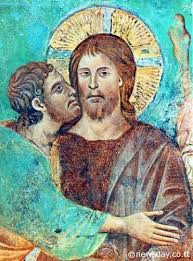
Judas' kiss to Jesus
According to the official theory of the church, Judas' kiss is nothing significant, it's just Judas hypocritically kissing Jesus. But there is a logical error here – if Judas really hated Jesus as the church theory says, he would certainly not have kissed him, it is after all an expression of love. And the group that was with Judas knew very well who Jesus was, it was not at all necessary for Judas to mark Jesus with some secret sign of a kiss. The church's view has many inconsistencies.
What is really logical and fits nicely is that the chosen apostle, the disciple, is Judas, where it is said that there was an intimate relationship between Jesus and Judas, that Judas had his head laid on the area between Jesus' legs.
The Gospel According to Luke – Chapter 22
47 While he was still speaking, a crowd appeared, and the one called Judas, one of the Twelve, was leading them. He approached Jesus to kiss him.
48 But Jesus said to him, "Judas, are you betraying the Son of Man with a kiss?"
Peshitta translations, verses: 47 , 48
Westcott-Hort Greek text of the NT – with Strong's numbers and morphology
Kralice Bible with Strong's numbers and morphology (NT – 1613)
Other scientific facts that confirm that a homosexual relationship between Jesus and Judas was highly probable
- I have addressed the issue of "Manipulation of Bible translations on the topic of homosexuality and in general" in a separate article.
- we cannot read the Bible from the perspective of our current culture but in the context of that time. The theological discipline of hermeneutics significantly supports the hypothesis of a homosexual relationship
- If we read the Bible with a 21st-century mindset, a partnership between Jesus and Judas would be an absurd hypothesis. On the contrary, in the context of that time, it is highly probable.
- This is an absurd hypothesis for a person who does not have sufficient knowledge of history, as sexuality and partnerships were perceived radically differently in prehistoric times.
- There is an expert consensus among experts who have analyzed the translations of the Bible in the book of Leviticus on the topic of homosexuality. Leviticus 18:22, 20:13 are badly translated verses, they do not concern homosexuality but adultery. For this reason, homosexual relations among Jews did not cause scandal in the times when Jesus was active.
- Something like "bisexual culture" was widespread on practically the entire planet Earth. Homosexual relationships were incomparably more significant in prehistoric times, culturally, sociologically, and demographically, than they are today. We do not assume that the area where Jesus operated was an exception. The homosexual relationship between Jonathan and David only confirms this.
In conclusion,
First of all, I would like to point out that the Peshitta is a true Biblical original and my translations of the given passages are truly correct and objective, with all due responsibility and honesty. I have gained good practice in translations and these translations are definitely not a mistake.
So what follows from these translations of the Peshitta?
With all due respect and love for Christians and the memory of Jesus, I must inform them that the Bible itself confirms the Gospel of Judas. The Church has decidedly tried to do everything to erase this real fact about Jesus from history, because such a thing would certainly not do Jesus or Christianity a good name. Bishop Irenaeus sharply criticized the Gospel of Judas. However, he forgot that the canonical gospels (the Bible) themselves say the same thing as the Gospel of Judas.
Christianity has over 2 billion followers. This large number of followers was ensured by the incredibly bloody spread of Christianity and the suppression of freedom of speech and discussion on Christian issues by the Inquisition. 2 billion people are currently in a huge error and ignorance about the person of Jesus. Jesus is not only not God, but he is not nearly as idealistic a figure as Christians imagine him to be.
Ancient Greek dictionary
https://www.lexilogos.com/english/greek_ancient_dictionary.htm
Related topic
Secret Gospel of Mark https://en.wikipedia.org/wiki/Secret_Gospel_of_Mark